 The Gulf Time Newspaper One of the finest business newspapers in the UAE brought to you by our professional writers and editors.
ABU DHABI/WAM
The Abu Dhabi Agriculture and Food Safety Authority (ADAFSA) is showcasing its ‘Farm to Factory’ framework during its participation in the Make it in the Emirates 2026 exhibition.
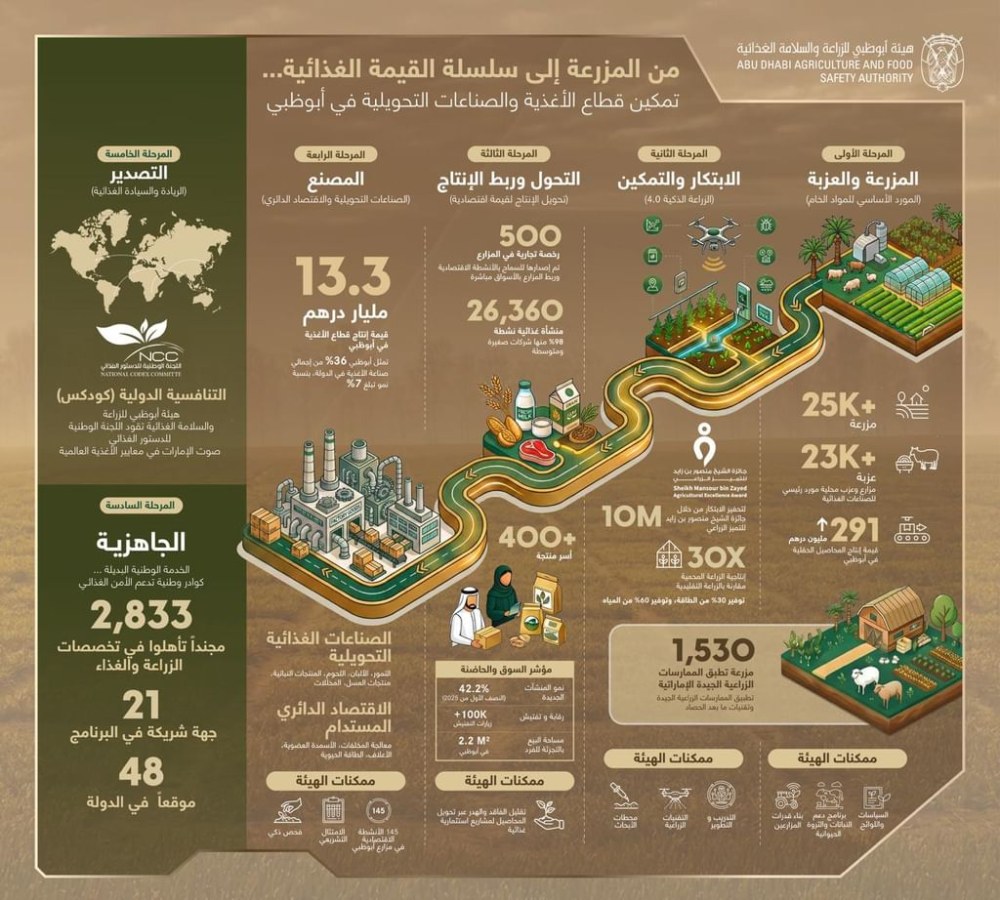
The framework aims to strengthen food value chains and advance food processing industries in the Emirate of Abu Dhabi, under the theme “From Farm to Factory… Abu Dhabi Creates Food Value.” It represents a strategic step towards positioning food industries as a cornerstone of sustainable agricultural development by linking local production with food manufacturing, enhancing economic efficiency, and reinforcing food security.
ADAFSA’s vision is anchored in a massive production base of more than 25,000 farms and 23,000 livestock holdings, which serve as the primary source of raw materials for the Emirate’s food industries. In 2023, the field crop sector achieved a production value of AED 291 million, while the total value of food production reached AED 13.3 billion, raising Abu Dhabi’s share to 36% of the UAE’s total food manufacturing output.
On the entrepreneurial front, ADAFSA reported a 42.2% increase in newly registered food establishments during the first half of 2025 compared with the same period in 2024. The Emirate now hosts 26,360 active establishments, 98% of which are small and medium‑sized enterprises (SMEs). To support this momentum, the Authority has issued 500 commercial licences enabling the practice of approved economic activities on farms, strengthening direct links between producers and markets.
Abu Dhabi’s food processing sector continues to expand, with pioneering models in dairy, dates, honey products, and processed meats, alongside support for more than 400 productive families engaged in traditional food industries. ADAFSA is also advancing a sustainable circular economy by converting crop residues and agricultural waste into compound feed, organic fertilisers, and bioenergy.
ADAFSA’s strategy focuses on transforming the agricultural sector from primary production into an integrated economic system. This includes diversifying processed products—such as date syrup, date paste, date pits, dairy products, cheeses, dried and processed meats, and bee products—while reducing waste through the utilisation of surplus produce in secondary industries such as jams and pickles. The approach also strengthens the circular economy by recycling agricultural and animal waste into feed, fertilisers, and bioenergy.
The initiative is supported by a comprehensive suite of legislative, technical, and human enablers. Legislative enablers include the approval of 145 economic activities permitted on farms and ADAFSA’s leadership of the National Codex Committee, which works to harmonise local standards with international requirements and facilitate the export of Emirati products.
On the technical side, the Authority is driving the adoption of Agriculture 4.0 technologies, which can increase production thirtyfold while reducing water consumption by 60%. Research and development efforts include the Agricultural Genome Project and the UAE Good Agricultural Practices (UAE G.A.P.) programme, complemented by the Sheikh Mansour bin Zayed Agricultural Excellence Award, which allocates AED 10 million annually to incentivise farmers, livestock breeders, and beekeepers.
In terms of human capital, ADAFSA provides specialised training for farmers, SMEs, and productive families. Additionally, 2,833 recruits have been trained under the Alternative National Service Programme to operate food facilities during emergencies. These efforts, supported by a smart inspection system, have raised community confidence in local products to 88%.
At the regulatory and international levels, ADAFSA leads the National Codex Committee in representing the UAE in the development of global food standards, facilitating the export of local products, and harmonising international specifications. The Authority also places strong emphasis on national readiness, training recruits in agriculture and food disciplines across 48 training sites in the UAE.
ADAFSA concluded its statement by reaffirming its commitment to advancing an enabling legislative environment, approving 145 economic activities for practice on farms, and supporting these activities with smart inspection systems that enhance compliance and ensure food safety—contributing to a community confidence level of 88% in the local food system.