 The Gulf Time Newspaper One of the finest business newspapers in the UAE brought to you by our professional writers and editors.
DUBAI / WAM
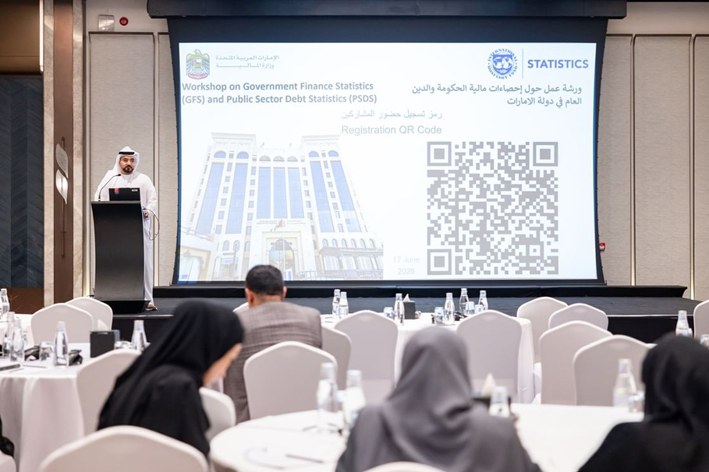
The Ministry of Finance, in collaboration with a technical mission from the International Monetary Fund (IMF), hosted a specialised workshop in Dubai on Government Finance Statistics (GFS) and Public Sector Debt Statistics (PSDS).
This joint initiative aims to reinforce institutional and technical capabilities in compiling and disseminating government financial data in line with international standards, while supporting the UAE’s efforts to advance its financial statistics system, enhance data quality, and promote greater integration across key macroeconomic statistics.
Saeed Rashid Al Yateem, Assistant Under-Secretary for Government Budget and Revenue Sector at the Ministry of Finance, affirmed that organising the workshop reflects the Ministry’s commitment to advancing the government financial data ecosystem and enhancing its ability to provide accurate and reliable data that supports financial planning and informed decision-making.
He noted that these efforts are aligned with the UAE’s vision to promote global best practices in public financial management.
“Government Finance Statistics and Public Sector Debt Statistics serve as twin pillars for strengthening fiscal transparency, improving the efficiency of government reporting, and offering a holistic view of public sector financial performance,” Al Yateem said.
“Investing in these areas is crucial to promoting fiscal sustainability and enhancing the country’s readiness to navigate evolving economic dynamics with efficiency and resilience.”
He added that the Ministry’s collaboration with the IMF reflects its commitment to leveraging international technical expertise and enhancing data compilation and dissemination practices in line with recognised standards.
It also supports stronger institutional coordination among relevant entities.
Together, these efforts help improve data quality and ensure greater consistency between financial statistics and other macroeconomic datasets.
The workshop featured an in-depth exploration of the Government Finance Statistics Manual 2014 (GFSM 2014), including its objectives, analytical tables, institutional coverage, and government financial reporting concepts. Participants also reviewed key concepts related to Public Sector Debt Statistics, including debt instruments, sectoral classification, valuation principles, and the public sector debt reporting framework.
The workshop further examined data dissemination standards and fiscal transparency requirements, including the Enhanced General Data Dissemination System (e-GDDS), the Special Data Dissemination Standard (SDDS), as well as data dissemination practices, metadata requirements, periodicity standards, and broader fiscal transparency principles.
Discussions also extended to the relationship between various macroeconomic statistics and the importance of ensuring coherence and consistency across Government Finance Statistics, Public Sector Debt Statistics, national accounts, balance of payments statistics, monetary and financial statistics, and other macroeconomic datasets. These discussions support the development of an integrated financial and economic data ecosystem.
The workshop also featured practical sessions reviewing the key findings and recommendations of the IMF technical mission, alongside discussions on data challenges and gaps, reconciliation issues, and proposed technical measures arising from the mission.
The deliberations further addressed the enhancement of practices related to the compilation of Government Finance Statistics and Public Sector Debt Statistics, improving data coverage and quality, and strengthening institutional coordination mechanisms among relevant stakeholders. This supports the implementation of a clear roadmap for the continued development of government financial data compilation.
This milestone workshop forms part of the Ministry of Finance’s ongoing efforts to strengthen coordination among relevant entities to ensure the alignment of government financial data with international reporting requirements. It also supports the development of collaborative mechanisms aimed at improving the efficiency of data compilation processes and enhancing the use of financial data in fiscal planning, economic analysis, and evidence-based policymaking underpinned by accurate, comprehensive, and integrated datasets.