 The Gulf Time Newspaper One of the finest business newspapers in the UAE brought to you by our professional writers and editors.
WARSAW/WAM
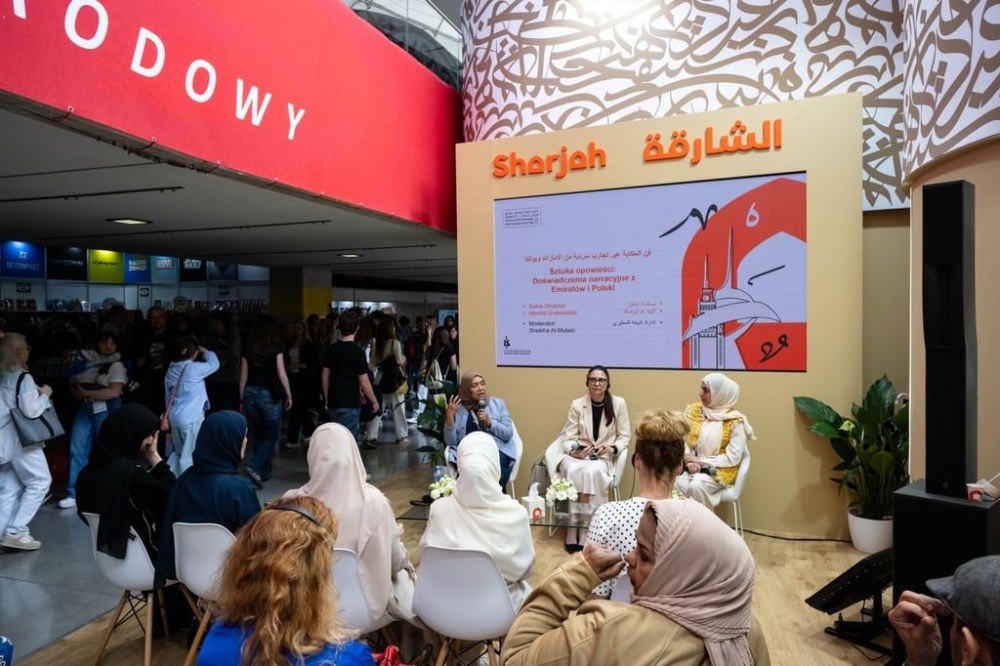
Sharjah’s Guest of Honour programme at the Warsaw International Book Fair 2026 highlighted the cultural and creative commonalities between Emirati and Polish literary experiences through discussions on storytelling, memory, history and children’s literature.
The Sharjah pavilion hosted a discussion titled “The Art of Storytelling through Narrative Experiences from the UAE and Poland”, featuring Emirati writer Saleha Ghabesh and Polish novelist Albena Grabowska.
The conversation explored how memory, history, and translation enable stories rooted in local experience to resonate with readers around the world.
The session brought together the two authors to reflect on the relationship between storytelling, memory, history, and place, and how literature can cross cultural and geographical boundaries while remaining deeply connected to its origins.
While memory remains central to fiction, Ghabesh said it is ultimately shaped by the writer through language, culture, and craft.
“The most local stories are often the ones that travel the furthest,” Ghabesh said, arguing that literature resonates across cultures when it remains faithful to the details of place while exploring emotions and experiences shared by people everywhere.
For her part, Grabowska described storytelling as an extension of the memory of women, families, and small communities. She said much of Polish literature is rooted in what she called “small homelands”, the places where people grow up and the memories passed down through generations.
Grabowska also addressed the challenges of bringing literature from one culture to another, arguing that translation involves far more than transferring words between languages. It requires preserving a work’s cultural nuances and deeper meanings while making it accessible to new readers.
In another discussion titled “The Diversity of Human Experiences in Emirati and Polish Fiction”, Emirati poet and novelist Dhaen Shahin and Polish novelist Wit Szostak explored how fiction helps societies understand memory, history, and identity.
The discussion examined how fiction serves as a space for preserving individual and collective memory and reinterpreting history as a living human experience that transcends geographical boundaries and connects people through their social and cultural transformations through storytelling.
Shahin and Szostak stressed that culture remains one of the most important bridges between peoples, noting that literature, novels, short stories, and historical and cultural studies together constitute a shared intellectual and human repository that fosters dialogue between communities across geographical and cultural boundaries.
Sharjah’s Guest of Honour programme also explored the present and future of children’s literature in the UAE and Poland.
The Sharjah pavilion hosted Emirati author Nadia Al Najjar and Polish author Barbara Kosmowska in a discussion titled “Children’s Literature in the United Arab Emirates and Poland: Between Innovation and Renewal”, which explored changing reading habits, the growing influence of technology, and the evolving relationship between young readers and books.
Al Najjar said successful writing for children begins with understanding the interests, language, and concerns of each age group, from early childhood through to young adulthood, noting that each age group has its own language and interests.
She argued that one of the greatest challenges facing children’s authors today is finding original stories capable of competing with the constant distractions presented by digital devices and online content, encouraging children to turn away from screens and towards books.
Kosmowska said many of the challenges facing children’s literature in Poland closely mirror those in the UAE. Books, she noted, no longer occupy the central place they once held in children’s lives due to the growing influence of technology and screens.
She added that authors today must engage not only children, but also parents, who often play a decisive role in shaping reading habits and encouraging engagement with books, as they remain the primary gateway to the world of reading and storytelling.