 The Gulf Time Newspaper One of the finest business newspapers in the UAE brought to you by our professional writers and editors.
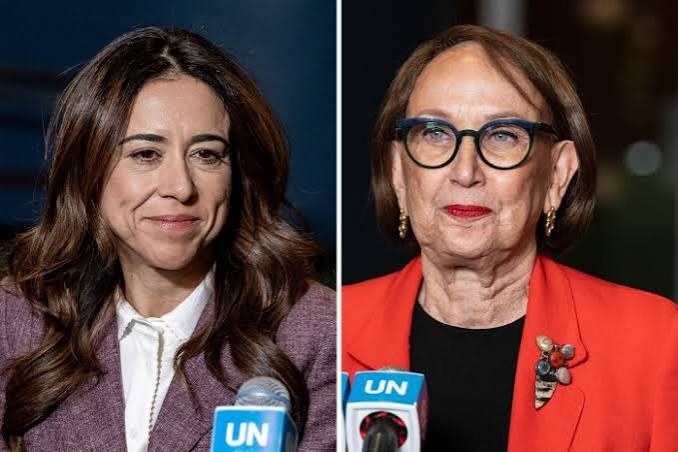
The UAE’s Lana Nusseibeh and Rebeca Grynspan Mayufis of Costa Rica are among the candidates for UN secretary-general
By James T. Areddy in New York and Yaroslav Trofimov in Abu Dhabi
With some of the most destructive conflicts since World War II ravaging the globe, the United Nations is confronting an uncomfortable question: Can a new leader make this international institution relevant again?
The U.N. Security Council will hold its ninth vote Thursday to decide who will succeed the current secretary-general, António Guterres, who will retire on Dec. 31 after a decade at the top. Of the eight candidates still in the running, two veteran diplomats have garnered the most attention: Costa Rica’s Rebeca Grynspan Mayufis, who says she can reform the U.N. from the inside, and Lana Nusseibeh, an influential United Arab Emirates official who is calling for “radical change.”
Grynspan has come out on top of nearly every one of the secret tallies since July and narrowly expanded her lead. Yet, she has continued to face opposition from veto-wielding permanent members, believed to include the U.S. Nusseibeh faces a potential make-or-break moment Thursday, after coming in fourth in the last poll despite her prominent profile. Argentine Rafael Grossi, the chief of the International Atomic Energy Agency, has polled at No. 2 but his candidacy is believed to face stiff opposition from Russia and the U.K. In an interview, Grynspan said the U.N. must revive its core mission of peace making.
“We are absent on all the scenarios of conflict in the world, and people see that,” said Grynspan, 70 years old, who has held prominent government positions at home and internationally for the U.N. “This is an organization that has become very risk averse.” Nusseibeh, who served as U.A.E. ambassador to the U.N. and later as minister of state of foreign affairs for the Persian Gulf nation, said she sees herself as a transformational leader who would become a “geopolitical secretarygeneral.”
“This particular race for the secretary-general has gathered so much interest because people see it as a turning-point moment for the international system,” she said in an interview. “What we require is a radical change in culture, in mindset, in approach, and in how we measure delivery.” Nusseibeh faces intense opposition from some corners of the U.N., particularly because of her country’s involvement in Sudan’s bloody civil war. She is believed to enjoy backing from the U.S. and Russia, while China is on record expressing support for a Latin American secretary-general.Nine days after she entered the race in October, Turkey—which favors the opposing side in that Sudan war—nominated a former foreign minister, Feridun Hadi Sinirlioğlu, seemingly to undermine the Emirati candidate. Asked about Sudan, Nusseibeh said that she will be an independent secretarygeneral if elected, with allegiance to the U.N., its charter and international law. “Dealing with Sudan,” she said, “is going to be the litmus test of success for any incoming secretary-general.”
If either Grynspan or Nusseibeh wins, it would be historic: The U.N. has never been led by a woman. Grynspan would be the first leader of Jewish origin, while Nusseibeh, the youngest candidate at 48, would be both the first Muslim and person of Palestinian descent at the top of the institution. Either woman would be a contrast to the current leader, Guterres.
A product of an era of expanding globalization, the former Portuguese prime minister has been undermined by the U.N.’s big powers: Russia and the U.S. started wars and two Trump administrations have slashed the organization’s budget.
The candidates to succeed Guterres pledge to more aggressively assert the U.N.’s role in major issues that involve the big powers, and they have no illusions that funding will return. Picking Guterres’s successor has been a drawn-out process that in itself is emblematic of the U.N.’s paralysis in recent years. To be recommended to the full U.N. membership, a candidate needs at least nine “encourage” votes from the Security Council and zero in the “discourage” category from the veto-wielding five permanent members. There is no clarity on who will run the U.N. if the succession process extends beyond year-end.
Grynspan and Nusseibeh both have notable diplomatic accomplishments. As head of the U.N. Trade and Development agency in 2022, Grynspan helped lead an initiative that temporarily protected Black Sea grain shipments early in the Russia-Ukraine war. Nusseibeh, while the U.A.E. representative to the U.N., steered a 2023 resolution that allowed food shipments into Gaza during Israel’s war on Hamas. “We need an activist, determined secretary-general of the U.N. who doesn’t mind risking failure in order to try and achieve success,” former U.K. Foreign Secretary David Miliband told a conference in Paris last week. Grynspan agrees. “The risk appetite has to come from the leadership, and the leadership has to bear the cost of failure,” she said.
Like the secretary-general she most admires, Nobel Peace Prize laureate Kofi Annan of Ghana, Grynspan hails from a small but stable country that isn’t caught up in the world’s great geopolitical power struggles. In the past, that may have served her well, but the U.A.E.’s global influence—especially its ability to speak to competing powers like the U.S., Russia and China and serve as a neutral ground for peace talks on Ukraine—is part of Nusseibeh’s appeal.
While raised in the U.A.E., she hails from one of Jerusalem’s most prominent Palestinian families. Her Cambridge-educated father, Zaki Nusseibeh, came to Abu Dhabi after the 1967 war, initially as a journalist, and ended up serving as one of the closest advisers to the U.A.E.’s founder, Sheikh Zayed al Nahyan. This personal history made her appreciate the international system that is now under threat, Nusseibeh said. “I want to be part of the regeneration of the system because I think it will keep us safe for decades if it is renewed and reoriented towards being credible and impactful on the ground for the people it serves,” she said.
ABOUT THE AUTHORS
James T. Areddy is a China-focused correspondent for The Wall Street Journal. James began reporting for the U.S. newspaper and Dow Jones & Co. in the late 1980s and has written stories for many sections of the Journal and its affiliate publications.
Yaroslav Trofimov is the chief foreign-a airs correspondent of The Wall Street Journal, providing reported analysis of major issues and developments around the world.
This article was first published in The Wall Street Journal on November 17, 2026
Can a New Leader Make the U.N. Relevant Again?