 The Gulf Time Newspaper One of the finest business newspapers in the UAE brought to you by our professional writers and editors.
DUBAI/WAM
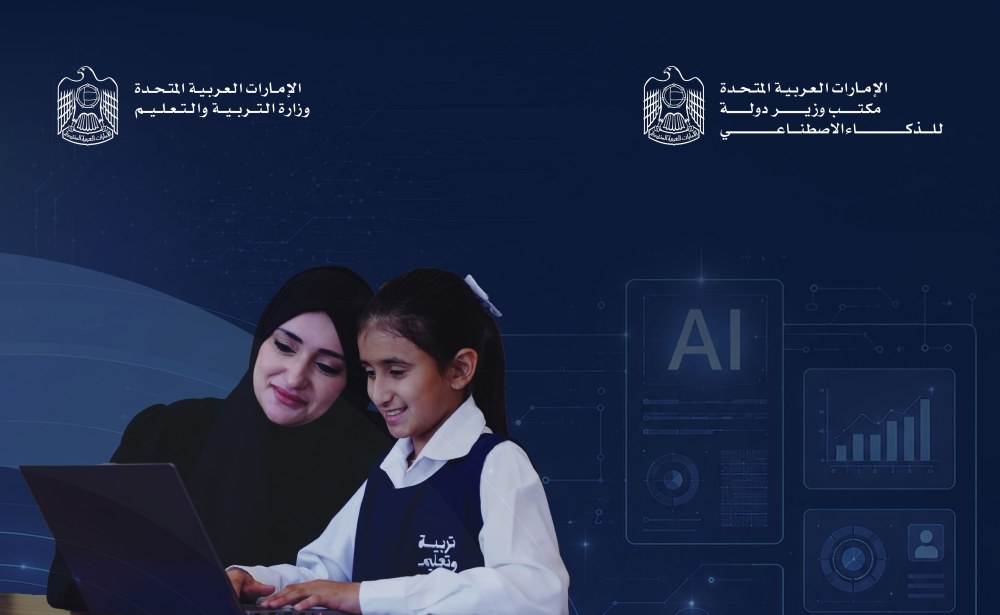
The Ministry of Education and Minister of State for Artificial Intelligence Office have launched the ‘Parent’s Guide to Artificial Intelligence in Education’, a national initiative designed to empower parents to navigate the rapidly evolving education landscape, raise awareness of the opportunities AI offers to support their children’s learning journey, and foster a culture of responsible technology use, equipping future generations with the knowledge and skills needed to thrive in a technology-driven world.
The launch forms part of national efforts to enhance society’s readiness for rapid technological advancements and builds on the UAE’s pioneering efforts to integrate AI into school curricula. It further strengthens collaboration between families and schools, extends AI literacy across society, and reinforces the role of parents as key partners in developing their children’s capabilities and guiding their educational experiences in the digital age.
Sarah bint Yousif Al Amiri, Minister of Education, emphasised that the development of the UAE’s education system is founded on an effective and integrated partnership with families to foster a safe and stimulating learning environment that keeps pace with global developments and harnesses the opportunities offered by emerging technologies to enhance educational outcomes and develop students’ capabilities.
She said: “The role of families in education is becoming increasingly important as artificial intelligence continues to advance, offering new opportunities to transform learning methods and enrich educational experiences. We are committed to equipping parents with the knowledge and practical guidance they need to navigate these developments, help their children benefit from emerging technologies safely and responsibly, and nurture their intellectual curiosity and capacity for lifelong learning.”
She added: “This guide reflects our commitment to strengthening collaboration between schools and families and raising wider societal awareness of the importance of responsible AI use in education. It aligns with the Ministry’s efforts to develop an agile and sustainable education system that places students at the heart of the learning process and equips them with the knowledge, skills and values needed to succeed in the future.”
Omar Sultan Al Olama, Minister of State for Artificial Intelligence, affirmed that the UAE adopts a proactive vision to prepare a society capable of keeping pace with technological advancements and contributing to shaping them. This reflects a national approach founded on the belief that shaping the future begins with investing in people, and that investing in future generations starts with the family, as the foundation of society and the source of the values that guide a nation’s progress.
He said: “In the UAE, we believe that nurturing future generations begins with cultivating awareness, and that the family is the first school, shaping individuals long before institutions do. Today, as artificial intelligence reshapes the world, this responsibility extends to preparing future leaders to understand these technologies, lead their development and shape their future. Our ambition is to nurture a generation equipped with the knowledge to anticipate global transformations and grounded in the values that preserve its identity.”
He added: “We aim to make knowledge accessible to every family and strengthen parents’ ability to guide their children towards the responsible use of these technologies.”
The guide provides parents with an accessible reference to help them understand the fundamental concepts of artificial intelligence and its key applications in everyday life. It introduces technical concepts such as machine learning, generative AI, algorithms and data, enabling families to better understand how these technologies work and their impact on children’s lives.
The guide explores the impact of AI use across four key areas of child development: cognitive development, social and emotional development, physical health and development, and digital and ethical development. It highlights the opportunities AI offers to enhance learning, creativity and problem-solving, while emphasising the importance of balanced technology use that reflects children’s needs at different stages of development.
It also provides practical guidance to help parents oversee their children’s use of AI tools, encourage open family conversations about technology, verify the accuracy of AI-generated information and content, safeguard personal data and privacy, and promote the values of honesty, integrity and digital responsibility.
The guide encourages families to explore AI tools together through shared educational activities and experiences, establish healthy boundaries for the use of digital devices and applications, and consider children’s age, maturity and level of understanding. This supports a balanced approach to harnessing the potential of technology while preserving independent thinking, communication skills and social interaction.
A dedicated section of the guide introduces parents to the artificial intelligence curriculum developed by the Ministry of Education under the directives of His Highness Sheikh Mohammed bin Rashid Al Maktoum, Vice President and Prime Minister of the UAE and Ruler of Dubai. Introduced in public schools from the 2025–2026 academic year, the curriculum aims to equip students with the knowledge and skills needed to understand artificial intelligence, explore its applications and use it responsibly.
The guide outlines the curriculum’s seven core areas: AI fundamentals; data, algorithms and machine learning; the use of AI tools; ethics and fairness; AI applications across society and various sectors; innovation and project design; and policies and responsibility.
It also introduces a range of practical tools and applications that can support learning, with illustrative examples of how they can be used to develop educational activities, simplify scientific concepts, create original content, design games and projects, and prepare study plans. These examples enable parents to explore how AI can enrich their children’s educational experiences.
The guide also addresses frequently asked questions from parents about artificial intelligence, teaching and student assessment methods, teacher training, and the integration of AI with other school subjects, providing families with greater insight into the learning process and enabling them to support their children’s education more effectively.
The guide is available at: https://ai.gov.ae/wp-content/uploads/2026/11/Parents-Guide-Remake-English-1.pdf