 The Gulf Time Newspaper One of the finest business newspapers in the UAE brought to you by our professional writers and editors.
DUBAI / WAM
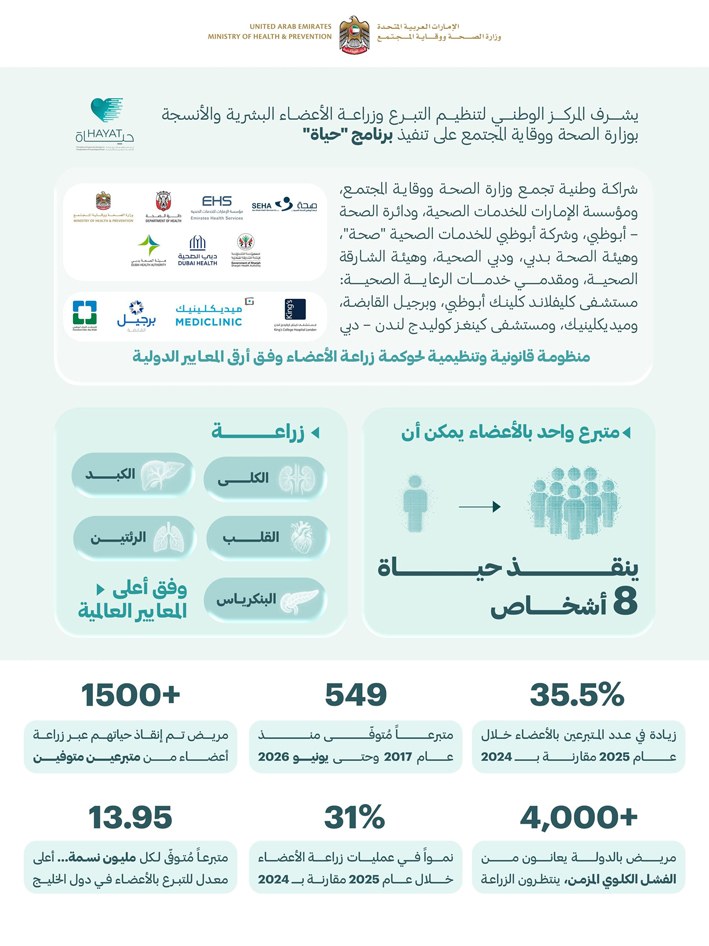
The Ministry of Health and Prevention (MoHAP) has unveiled milestone achievements of the National Programme for Donation and Transplantation of Human Organs and Tissues, “Hayat”, which has contributed to saving the lives of more than 1,500 patients in the UAE through organ transplantation from deceased donors since the programme was launched in 2017 through June 2026.
The cumulative number of organ donors reached 549 deceased donors, reflecting the rapid advancement of the national health system and its ability to transform humanitarian giving into new opportunities for life.
These achievements embody the vision of wise leadership, which has established human health and quality of life as a national priority and developed an advanced healthcare model that combines healthcare efficiency, humanitarian values and progressive legislation.
This approach has contributed to strengthening the UAE’s position regionally and globally in organ donation, retrieval and transplantation, underpinned by an integrated system that applies to the highest standards of quality and safety and places the needs of patients and their families at the heart of health policies and services.
Since its establishment, the “Hayat” Programme has successfully facilitated the transplantation of 1,780 organs, including 924 kidneys, 502 livers, 181 lungs, 151 hearts and 22 pancreases. Organ transplant services in the UAE are provided through nine accredited centers.
In Abu Dhabi, Cleveland Clinic Abu Dhabi performs heart, lung, liver, kidney and pancreas transplants; Sheikh Khalifa Medical City provides liver and kidney transplantation for adults and children; while Burjeel Medical City performs kidney and liver transplants.
This diversity reflects the availability of multiple specialties across accredited healthcare facilities, including dedicated programme for patients of different age groups.
In Dubai, Dubai Hospital provides kidney transplantation services for adults, while Al Jalila Children’s Hospital specializes in pediatric kidney transplantation. Mediclinic performs kidney transplants for adults, while King’s College Hospital London – Dubai provides liver transplantation services for adults and children, as well as living-donor kidney transplantation for adults. In Sharjah, Al Qassimi Hospital provides kidney transplantation for adults, while Medcare Hospital performs living-donor kidney transplants for adults.
The “Hayat” Programme contributes to establishing a more efficient and sustainable world-class healthcare system, expanding access to specialized treatment services and leveraging advanced medical technologies to improve transplant outcomes. The programme also translates the UAE’s vision for a healthcare sector focused on prevention, innovation and quality of life, while linking healthcare progress to tangible outcomes that enable patients to regain their health, return to their families and communities, and resume their lives normally, thereby supporting the objectives of the “We the UAE 2031” vision.
The UAE ranked first among GCC countries, with a rate of 13.95 deceased donors per million population, reflecting the success of national policies and the integration of efforts among the various stakeholders. The country provides world-class organ transplantation services in accordance with international best practices, supported by advanced healthcare infrastructure, multidisciplinary teams, licensed facilities, and rigorous systems for evaluating donors and recipients and ensuring organ compatibility and safety prior to transplantation.
The number of donors in 2025 increased by 35.5% compared with 2024, alongside a 31% increase in organ transplantation activity over the same period. In coordination with health authorities, the Ministry is working to build sustainable capabilities in organ donation, preservation, transportation and transplantation, drawing on the latest studies on leading technologies and practices in the field of organ failure diseases, thereby supporting the sustainability of healthcare services for future generations.
The journey of the “Hayat” Programme reflects the UAE’s longstanding humanitarian approach, which places people at the heart of development and transforms the values of giving, solidarity and social cohesion into life-saving health outcomes that offer patients and their families renewed hope. A single organ donor can save the lives of up to eight people, giving every decision to donate a far-reaching impact that extends to entire families and communities, while preserving the legacy of donors as partners in enhancing quality of life and as a source of inspiration for responsible community participation.
The progress achieved by the UAE takes on particular significance in light of patients’ needs, with more than 4,000 people in the country suffering from chronic kidney failure awaiting the hope of a new life. The programme seeks to expand organ availability and reduce waiting times by increasing awareness of donation, accelerating evaluation and matching procedures, developing living-donor and paired-donation programmes, and strengthening cooperation with specialized centers inside and outside the UAE, thereby increasing patients’ chances of receiving the appropriate treatment at the right time.
The Ministry of Health and Prevention, through the National Centre for Regulation of Human Organ and Tissue Donation and Transplantation, oversees the implementation of the programme and regulates procedures for donation, retrieval, preservation, allocation, transportation and transplantation. The Centre’s mandate also includes developing policies and licensing standards, overseeing healthcare facilities, creating the conditions necessary for successful transplantation procedures, ensuring the quality and safety of organs and tissues, and supervising the training and continuous professional development of healthcare personnel, thereby standardizing practices and enhancing the efficiency of the national system.
In cooperation with its partners, the Ministry has also accredited and trained more than 10,000 healthcare professionals in the field of organ donation, while the “Hayat” Programmr has established a specialized national network comprising more than 150 healthcare professionals who provide round-the-clock support throughout the various stages of donation and transplantation, from identifying potential donors and supporting their families to organ retrieval and transportation, transplantation procedures and post-transplant patient care. Organ donation and transplantation is a highly precise and complex process involving more than 20 medical and allied healthcare specialties across multiple healthcare facilities.
The UAE has reinforced these achievements by developing a flexible and advanced legislative framework that keeps pace with medical and scientific progress. Federal Decree-Law No. 25 of 2023 and its Executive Regulations form the regulatory foundation, establishing a comprehensive framework to support a culture of donation, ensure the equitable allocation of organs according to patients’ health status, protect the rights of donors and recipients, provide them with appropriate care, apply innovative solutions, and expand opportunities for cooperation and integration with countries and regional and international centres.
The legal framework ensures that organs are allocated based on medical criteria, degree of compatibility and clinical priority. It also regulates living donation and bequests for donation after death, permits donation between relatives up to the fourth degree and between spouses and their relatives, and allows paired donation between different families where biological compatibility cannot be achieved between a patient and their intended donor.
This expands treatment options and enables cases of incompatibility to be converted into successful transplant opportunities under clear regulatory controls.
The national organ donation and transplantation system places the safety of living donors at the highest priority throughout all stages, beginning with a review of their medical history and an assessment of their physical and psychological condition, followed by blood tests, biological compatibility testing and medical imaging, through to health counselling and preparation for surgery.
Healthcare facilities apply surgical techniques designed to support faster recovery, while monitoring vital signs and implementing appropriate sterilization and anesthesia procedures, followed by the necessary post-operative care, including treatment, nutrition, psychological support and medical follow-up.
Ministerial Decision No. 91 of 2026 reinforces this protection through an integrated framework of recognition and therapeutic, insurance and in-kind benefits for donors and their families, reflecting national appreciation for their humanitarian initiative and enhancing the programme’s appeal within the community.
Eligible beneficiaries include living donors and their relatives up to the fourth degree, individuals who have expressed their wish to donate or have made a bequest for donation and their relatives, as well as the relatives of deceased donors. They are granted priority where an organ or tissue transplant is required, subject to their health condition and assessment by the National Center and the relevant authorities.
In-kind benefits include accommodation arrangements near the treating hospital for donors or patients’ companions, support for travel and transportation costs, assistance related to the donor’s recovery period and absence from work, and home-care services, in addition to certificates and medals of recognition, official letters of appreciation, documentation of donors’ humanitarian stories, and psychosocial support programmes for the families of deceased donors.
Insurance benefits include comprehensive medical and insurance coverage for living donors for all examinations and procedures related to donation. Therapeutic benefits cover admission, accommodation and required healthcare services, continuous follow-up of the donor’s health after donation, and ensuring the continuity of insurance coverage and care associated with the procedure. This reflects an integrated vision that regards donor care as an integral part of successful transplantation and the long-term sustainability of the programme.
The UAE continues to update its legislation to accommodate the future of organ transplantation, by regulating the concept of non-human organs and tissues, including animal organs and organs manufactured using 3D bioprinting, tissue engineering and advanced technologies. The legal amendments have established precise requirements for licensing, clinical and laboratory testing, biological safety, biocompatibility and informed consent, along with the establishment of a national database to document these organs, their sources, trial results, transplantation stages, and assessments of efficacy and safety.
The achievements of the “Hayat” programme reflect an advanced level of clinical competence in organ transplantation, as kidney transplants achieved a survival rate of 96.5% after a year, with the transplanted kidney maintaining its functional efficiency by 99%, lung transplantation recording a survival rate of 91.4%, while all transplanted lungs maintained their function by 100%, and the survival rate of heart transplant patients during the first 30 days after surgery reached 95%, with the transplanted heart maintaining its functional efficiency at 89.5%, while liver transplantation achieved a survival rate of 93%, with the transplanted liver retaining its function at 92.3%.
On the technical level, HAYAT programme is based on innovation to increase the efficiency of donation and transplantation services, including mechanical perfusion systems, and the use of artificial intelligence to support organ quality assessment, improve matching accuracy, and predict the outcome of operations.
The UAE also witnessed the first robotic lung transplant operation, which is part of a limited group of leading countries in performing these complex operations, an achievement that reflects the development of the health infrastructure, the efficiency of specialized teams, and their ability to employ modern technologies in the service of patients.
The National Center for Regulation of Human Organ and Tissue Donation and Transplantation strengthens the data system by establishing and managing a national database that includes patients in need of transplantation, living donors, donors, and individuals who have registered to donate after death, and data and tracking of removed organs and tissues, in order to support health planning, manage waiting lists, quickly identify opportunities for compatibility, measure outcomes, and make data-driven decisions, as well as provide a basis for developing policies, research, and anticipating the future needs of patients, facilities, and staff.
The programme’s achievements are based on a broad national partnership that brings together the Ministry of Health and Prevention, health authorities, care providers in the public and private sectors, as well as specialized facilities, ambulance teams, laboratories, regulatory and logistical authorities.
This integration allows for the coordination of donor identification, organ assessment, and transfer at critical times, the preparation of recipients, the performance of transplant procedures and the follow-up of results, within an interconnected chain of work based on clear roles, rapid response and standardized criteria at all stages of donation and transplantation.
The cooperation extends to the regional and international level through partnerships with specialized institutions and centers, and the exchange of experiences, knowledge and organs in accordance with the approved legislation and agreements.
More than 550 organs have been exchanged between the UAE, Saudi Arabia and Kuwait, alongside the signing of bilateral agreements with Kuwait and the establishment of a cooperation network that supports training, capacity building, the exchange of expertise, and facilitates organ sharing for urgent cases, thereby expanding treatment options for patients, strengthening health integration, and developing organ transport networks and logistics.
Community awareness is a key pillar in the expansion of the programme, as the Ministry works to provide reliable information that explains the concept, procedures and impact of donation, and highlights the stories of donors and recipients to highlight the human dimension of the decision. The campaigns target various segments of society through media content, workshops and field events, and encourage registered donors to share their decision with their families, thereby facilitating procedures when needed and transforming donation into an established community culture that reflects compassion, solidarity and shared responsibility.
Future directions include strengthening the integration of organ donation into the health system through the establishment of specialized units within hospitals, staffed by trained doctors and nurses to identify potential donors, support donors’ families and coordinate donation procedures.
The presence of these units enhances hospitals’ ability to identify donation opportunities at an early stage and manage the related procedures in an organized manner, thereby supporting increased availability of transplantable organs and reducing waiting times for patients in need of life-saving organs.
The strategic priorities of the “Hayat” programme also include expanding donation pathways through donation after circulatory death (DCD), alongside expanding tissue donation programmes to include corneas, bones, skin and heart valves, in addition to expanding transplantation services to include the intestine, uterus and vascularized composite tissues, such as face, hand and arm transplantation.
Dr. Amin Al Amiri, Assistant Undersecretary of the Health Regulation Sector at the Ministry of Health and Prevention, stressed that the achievements of the “Hayat” programme embody the vision of the wise leadership in building a global health system that puts the human being at the heart of its priorities, and strengthens the UAE’s position as a leading center in organ donation and transplantation, noting that these achievements reflect the integration of advanced legislation, national competencies, advanced health infrastructure and modern technologies, which has enabled the provision of qualitative treatment opportunities for patients with organ failure and strengthened confidence in a national system based on efficiency, transparency and excellence.
He added: “We are continuing our efforts to develop the “Hayat” programme according to ambitious plans based on expanding the scope of donation, benefiting from the latest medical technologies, promoting research and innovation, and building effective regional and international partnerships, in addition to consolidating community awareness of the importance of organ donation as a great humanitarian message, which is reflected in the increasing demand for registration for donation within the programme, which confirms the growing culture of giving in the community, and motivates us to continue developing services and improving the quality of care, giving more patients a new opportunity for life and a more stable future.”