 The Gulf Time Newspaper One of the finest business newspapers in the UAE brought to you by our professional writers and editors.
ABU DHABI / WAM
The world is experiencing rapidly escalating challenges that are reshaping cross-border organised crime involved in the trafficking and distribution of drugs. Today, psychoactive substances are engineered in illicit labs using complex chemical formulas and synthetic compounds.
The promotion of these substances across digital platforms has compounded the challenge of combating this threat. This is further exacerbated by the integration of drugs into e-cigarettes and vapes, making detection by families and authorities significantly more difficult.
Faced with this complex global landscape and the surge in international addiction statistics, countering the threat demands a fresh approach, innovative methods and complete community partnership. Recognising this early on, the UAE adopted a comprehensive and decisive framework through the launch of the National Anti-Drugs Strategy 2024-2031. This strategy is built on scientific, digital and social pillars designed to confront modern crime with equally modern tools.
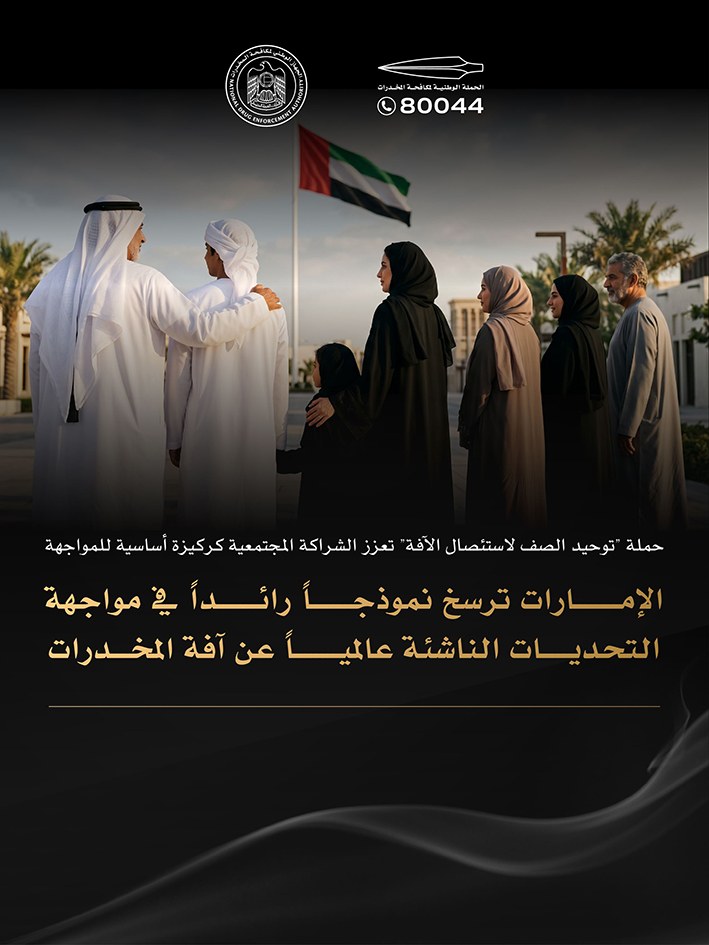
To translate this community partnership into tangible action, the National Drug Enforcement Authority, in collaboration with the UAE Government Media Office, launched the National Campaign for Drug Enforcement under the theme ‘United as One to Eradicate the Threat.’ The initiative spearheads a comprehensive, sustainable movement that reinforces the foundations of drug prevention.
Latest data from international organisations reveals an unprecedented surge in new synthetic drugs. Reports by the United Nations Office on Drugs and Crime (UNODC) indicate that over 1,200 new synthetic substances have been identified. These lab-made poisons now dominate the modern drug market due to their low production costs and ease of manufacturing. As a result, these substances have become the leading cause of death among youth and middle-aged demographics in several Western societies, ranking above physical diseases and traffic accidents.
Data from the US Centres for Disease Control and Prevention (CDC) attributes a substantial portion of global overdose fatalities to synthetic opioids like fentanyl, which is 50 times more potent than heroin. The extreme danger lies not only in its high toxicity but also in illicit labs’ inability to measure the exact ratios of the chemicals within these substances. A microscopic error of just one milligramme during formulation can instantly turn a stimulant or sedative into a fatal poison upon the very first use.
From a medical and behavioural perspective, the US National Institute on Drug Abuse (NIDA) explains that substances like crystal meth (shabu) or ‘Chemical’ inflict what can be described as a biological hijacking of the brain. These substances trigger a massive, sudden spike in dopamine levels by up to 1,200 percent. This shocking surge instantly destroys natural dopamine receptors, forcing the brain to biologically reprogramme itself, stripping away human free will and creates compulsive dependency from the very first dose.
With regards to digital promotion, UN reports show a major spike in the use of encrypted platforms and the dark web to distribute such substances, targeting adolescents directly in their own rooms.
Recent statistical studies also prove that using e-cigarettes (vapes) increases the likelihood of abusing other illicit substances, particularly given the difficulty families and educational institutions face in detecting laced oils and psychoactive materials in them. These challenges have driven the global number of drug users to 316 million people (aged 15 to 64), representing 6 percent of the world’s population in this age group. This reflects a 28 percent surge over the past decade, which is a staggering growth rate that far outpaces global population growth during the same period, indicating that the footprint of addiction is continuously expanding to ensnare new demographics.
In response to these global realities, the UAE has presented an exceptional model for safeguarding its youth and protecting society. Moving beyond traditional defensive measures, the nation took the initiative to develop a proactive ecosystem using modern tools that focus on deterrence, tech-driven proactivity, building collective immunity and providing treatment, rehabilitation and reintegration.
The UAE’s framework leverages data and AI to spearhead enforcement efforts. Security agencies rely on the latest technologies to monitor and analyse smuggling patterns across digital spaces, while tracking down and proactively dismantling drug-dealing accounts on social networks, in coordination with international partners. Furthermore, the UAE has intensified strict border control by tightening customs and security through smart scanning systems capable of detecting hidden shipments and complex chemical substances before they enter the country.
As part of its strategy to build collective immunity, the UAE focuses on fostering a comprehensive partnership among all community institutions, starting with families and schools. It coordinates efforts across all relevant entities to build self-protection among young people through specialised awareness programmes that equip them with the knowledge and the confidence to say no to any deception. The approach also focuses on training families in early detection and intervention skills.
To eliminate loopholes and prevent illegal medical exploitation, the UAE has also developed a national platform for controlled medications to ensure the responsible and safe use of prescription drugs that could lead to addiction if misused.
Treatment, rehabilitation and reintegration are key cornerstones of the UAE’s strategy. The nation provides advanced, confidential rehabilitation environments that ensure recovering individuals return to society as upright, productive citizens. This is coupled with occupational and social integration which supports recovery, facilitates entry into the job market and minimises the potential for relapse, alongside ongoing efforts to reduce the social stigma associated with past addiction.
Through these key pillars, the UAE model has successfully shifted the approach from criminalisation to empowerment and care. Rather than addressing the matter as a security issue, it tackles the human and social root causes of the problem to achieve a drug-free society through innovative national programmes that are built on fostering collective immunity. The UAE’s humane legislation serves as the ultimate foundation for the success of this model. Through the Hisn service at (80044), the National Drug Enforcement Authority offers a safe haven and a glimmer of hope for those seeking treatment and rehabilitation. The service guarantees absolute confidentiality, complete privacy, world-class medical and rehabilitation care, and total exemption from criminal liability.