 The Gulf Time Newspaper One of the finest business newspapers in the UAE brought to you by our professional writers and editors.
ROME / WAM
The UAE welcomed the decision adopted by the Food and Agriculture Organisation (FAO) Council, at a Special Session of the Council, as part of a UAE-led initiative, together with GCC Member States and partners, which included a condemnation of Iran’s actions that jeopardise food security. The decision addresses the implications for global food security and agriculture arising from Iran’s actions in the Strait of Hormuz as well as its targeting of vital infrastructure, including energy facilities, desalination plants, and food-related facilities, which has led to the disruption of supply chains in the Gulf region, including key maritime routes.
The decision was led by the UAE, together with GCC countries, Jordan, Egypt, Lebanon, and Morocco, and was adopted by consensus. The UAE expresses its appreciation to FAO Member States, and in particular all Council members for their constructive engagement in advancing this initiative within the FAO’s mandate.
The decision underscores the urgent need to prevent the politicisation of food and agriculture supply chains and to safeguard global food security, particularly for vulnerable and food-import dependent countries. It further emphasizes that secure and predictable flows of food, fertilizers, and agricultural inputs —supported by open and well-functioning trade routes — are essential to global market stability and the protection of affected populations.
The UAE affirms that the Strait of Hormuz is a vital international waterway and a true global lifeline, essential to the flow of energy, trade, and critical goods worldwide. Approximately one-fifth of the world’s energy supplies transit through it each day, alongside around 25 percent of global gas flows, nearly 70 percent of petrochemical needs, and approximately 30 percent of the fertilizers essential for global food production.
By referring to the United Nations Security Council Resolution 2817 (2026) – which was co-sponsored by 136 countries – the FAO decision reaffirms that the attacks carried out by Iran against countries in the region and beyond – including unprovoked attacks on civilian infrastructure and merchant and commercial vessels, and its disruptions to international navigation in the Strait of Hormuz constitute a breach of international law and a serious threat to international peace and security. It further highlights these attacks disrupt the production, transport, and supply of food and agricultural commodities, contributing to global market instability and food price volatility.
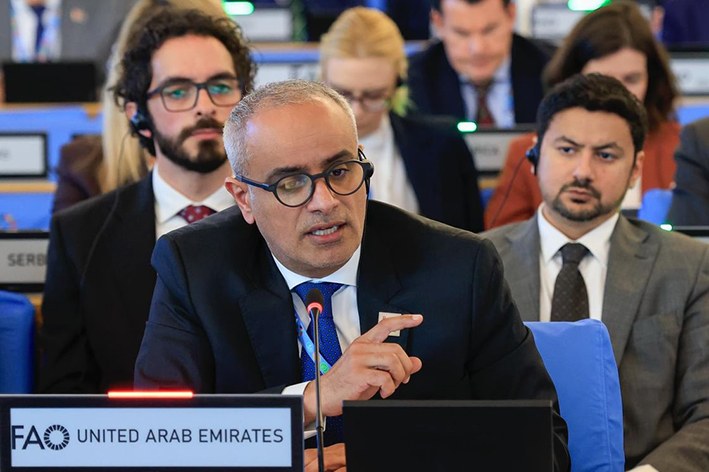
Abdulla Balalaa, Assistant Minister of Foreign Affairs for Energy and Sustainability, pointed out that the safety of global food and energy supply chains cannot be separated from the security of vital maritime routes. He emphasized that Iran’s escalation and its actions targeting critical civilian infrastructure carry far-reaching consequences that destabilize the region and the world, and directly impact markets and the most vulnerable populations globally. He stressed the need for the international community to act collectively to uphold international law, ensure freedom of navigation, and protect the continuous flow of essential goods that support global food security.
The decision further emphasizes the importance of maintaining open, secure, and well-functioning trade routes, including international waterways, and ensuring freedom of navigation in order to guarantee the uninterrupted flow of food, agricultural goods, fertilizers, and essential inputs, preserving market stability and protecting the most vulnerable populations.
It also requests the FAO to monitor and assess the impact of the Iranian disruptions on global food security, provide timely market information and early warnings, and to support FAO Member Nations, upon request, in strengthening the resilience of their agri-food systems.
The UAE remains committed to active and constructive engagement within the Food and Agriculture Organisation to strengthen international cooperation, enhance the stability of food systems, and put an end to Iranian violations that undermine global food security, including those affecting freedom of navigation.