 The Gulf Time Newspaper One of the finest business newspapers in the UAE brought to you by our professional writers and editors.
DUBAI/WAM
H.H. Sheikha Latifa bint Mohammed bin Rashid Al Maktoum, Chairperson of the Dubai Culture and Arts Authority (Dubai Culture), reviewed the progress of the Al Fahidi Fort rehabilitation project, launched by H.H. Sheikh Hamdan bin Mohammed bin Rashid Al Maktoum, Crown Prince of Dubai, Deputy Prime Minister, Minister of Defence, and Chairman of The Executive Council of Dubai. The restoration project aims to preserve Dubai’s heritage for future generations, ensuring the emirate’s oldest surviving structure remains a prominent landmark and cultural beacon.
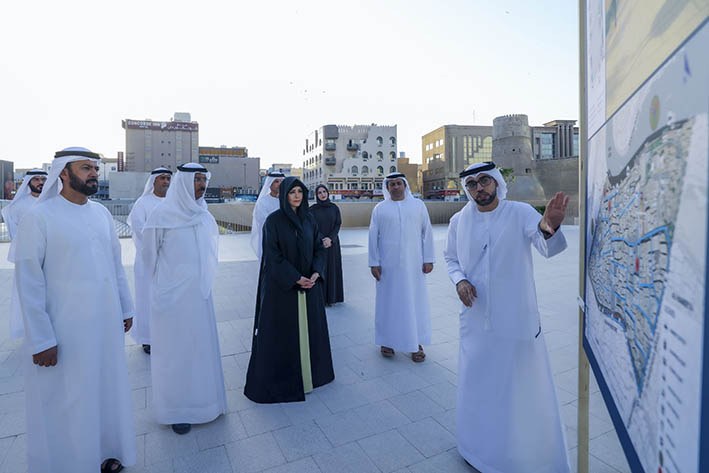
During a visit to the project site, Sheikha Latifa reviewed the final phase of the Al Fahidi Fort’s rehabilitation ahead of its reopening to the public as a museum experience. The Fort serves as a custodian of the city and a keeper of its memories, inviting reflection on what is preserved and what is carried forward. This work is part of Dubai Culture’s ongoing commitment to safeguard historic sites as living spaces that ensure future generations remain connected to their roots, while showcasing the museum’s rich collections.
The Fort is among Dubai’s earliest buildings and one of its most significant heritage sites, forming an integral part of the city’s collective memory. For over two centuries, it has witnessed the emirate evolve from its earliest days to international prominence. This transformation reflects the visionary leadership of His Highness Sheikh Mohammed bin Rashid Al Maktoum, Vice President and Prime Minister and Ruler of Dubai, whose forward-looking approach has positioned Dubai as a global centre for culture, an incubator for creativity, and a thriving hub for talent.
Accompanied by Helal Al Marri, Director-General of the Dubai Department of Economy and Tourism; Mohammed Al Murr, Chairman of the Mohammed bin Rashid Al Maktoum Library Foundation; Hala Badri, Director-General of Dubai Culture; and Major General Khalifa Rashed Al Hamli, Director of the Office of the Minister of Defence, Sheikha Latifa visited the historical Al Fahidi Fort and received a detailed briefing on the comprehensive restoration works underway at the site. She also viewed the galleries, which chronicle the Fort’s history from its construction in 1787 to the present day. Over this period, it served as a dynamic space that combined governance, judicial, and administrative functions. It also housed successive generations of rulers, who governed the emirate and made decisions that built the foundation for its modern prosperity.
Her Highness emphasised that Al Fahidi Fort is not just one of Dubai’s most prominent historical landmarks, but a defining point in the emirate’s modern story. She said: “Al Fahidi Fort stands as a reminder of where our journey began; within its walls lies the spirit of a city shaped by vision and belief in what could be achieved, reflecting the foresight of the late Sheikh Rashid bin Saeed Al Maktoum, who understood that enduring progress is built on strong foundations and clear purpose. The fort carries the memory of a community that safeguarded its values and traditions, and from that foundation, a global city emerged.”
H.H. Sheikha Latifa added, “Today, Al Fahidi Fort remains a cornerstone of Dubai’s cultural landscape and a key pillar of our cultural tourism offering, providing visitors with a meaningful window into our past and allowing them to experience the stories, traditions, and daily life that shaped our identity. Preserving such landmarks ensures that as we continue to build the future, we remain connected to the heritage that defines who we are.”
Al Fahidi Fort, scheduled to open in H1 2026, includes six main galleries and exhibition spaces featuring a wide range of artefacts, archival photographs, and historical documents. These are displayed using advanced digital media, audiovisual elements, and interactive 3D displays that tell the story of the site’s evolution over many decades. Before becoming the city’s first museum in 1971, it was already part of community life, serving as a keeper of memory and a source of shared identity.