 The Gulf Time Newspaper One of the finest business newspapers in the UAE brought to you by our professional writers and editors.
DUBAI / WAM
Dubai’s Roads and Transport Authority (RTA) has completed 13 cycling tracks as part of a master plan encompassing 15 tracks across various areas of the emirate, with a total length of 162 km.
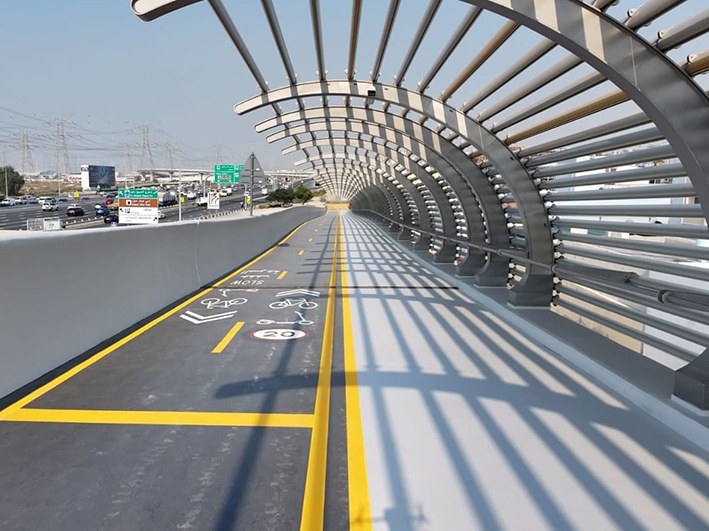
The project provides an integrated cycling network linking existing tracks from Al Khawaneej to Al Mamzar Beach, from Al Warqa’a to Saih Al Salam, and from Dubai International Financial Centre (DIFC) to Jumeirah. Work is also underway to complete a series of pedestrian and cycling bridges, set to be among the largest in the emirate. These include a bridge over Sheikh Mohammed bin Zayed Road, connecting Al Khawaneej track to Al Mamzar Beach; another over Dubai–Al Ain Road, linking Saih Al Salam track with tracks in Al Warqa’a and Al Khawaneej; a bridge over Sheikh Zayed Road, connecting cycling tracks in Al Sufouh and Jumeirah with the track along Hessa Street; and a bridge over Al Khail Road, linking Dubai Hills with the cycling track along Hessa Street and Mall of the Emirates. All tracks are scheduled to be opened during the second quarter of this year 2026. The development of cycling tracks forms part of a comprehensive plan to expand Dubai’s cycling network to 1,000 km by 2030.
RTA’s efforts in building an integrated cycling network have strengthened Dubai’s global standing, earning the emirate a place among the world’s top 100 cycling-friendly cities in the 2025 Copenhagenize Index, making it the first city in the Middle East to achieve this distinction. The Copenhagenize Index is a leading global benchmark for assessing cycling friendliness, based on key criteria including infrastructure quality, cycling usage rates, corporate support, and policies related to flexible mobility.
Mattar Al Tayer, Director General, Chairman of the Board of Executive Directors of the Roads and Transport Authority (RTA), said: “The expansion of pedestrian and cycling tracks and bridges reflects the directives of the UAE’s wise leadership to enhance road safety and provide a safe and sustainable mobility environment for all road users. The initiative also supports Dubai’s vision to become a pedestrian- and cyclist-friendly city, while enhancing quality of life and promoting the well-being of residents and visitors.”
“Both existing and planned cycling tracks form an integrated network linking residential areas across the emirate with key destinations and public transport stations, encouraging the use of bicycles and other sustainable individual mobility modes for first- and last-mile journeys.”
“The selection of track locations was based on comprehensive field studies, taking into account population density, land use integration, proximity to major tourism and economic destinations, and connectivity with public transport hubs. These factors contribute to improving traffic flow and enabling safe, smooth mobility for pedestrians and cyclists across Dubai’s road network.” Al Tayer added: “Dubai’s inclusion in the global Copenhagen Index marks a culmination of sustained efforts led by RTA to develop an integrated cycling network, in line with the Dubai Bicycle-Friendly Strategy, which has marked a step change in the concept of sustainable urban mobility. RTA’s initiatives have increased the total length of cycling tracks from 560 km at the end of 2024 to 636 km by the end of 2025, while cyclist satisfaction with cycling infrastructure in Dubai reached 85%.
The number of cycling trips rose from 46.6 million in 2024 to 57.3 million in 2025, representing a 23.5% increase. In addition, 22.3% of Dubai’s population now has access to cycling infrastructure.” The completed projects include the delivery of cycling tracks across multiple areas of Dubai, including Al Khawaneej 2 and Al Barsha 2 as part of the Model Residential Neighbourhoods Project, with a total length of 18.5 km — comprising 8 km in Al Khawaneej 2 and 10.5 km in Al Barsha 2.
The works also included a 700-metre cycling track in Tolerance District, alongside the implementation of the Soft Mobility Project, which introduced targeted mobility enhancements in and around public transport stations. The project covered Al Souk Al Kabeer, Hor Al Anz, and Abu Hail, in addition to five key public transport stations: BurJuman, Sharaf DG, Palm Deira, Baniyas, and Burj Khalifa/Dubai Mall.
In addition, the scope of work included the provision of 25 km of dedicated tracks for bicycles and e-scooters, the upgrade of existing pedestrian walkways, and the implementation of the Safe Streets concept across internal roads. The completed projects also include the delivery of 7 km of pedestrian, cycling, and micromobility tracks, designed to connect the area with ONPASSIVE Metro Station and Al Quoz Bus Station. The works further included the construction of a pedestrian and cycling bridge over Al Manara Street, enhancing the flow of movement for pedestrians and cyclists within the area and its surroundings.
he bridge incorporates aesthetic design elements that reflect the character and identity of the area and its facilities. It measures 45 metres in length, 5.5 metres in width, and 6 metres in height, and features access ramps on both sides, each extending 210 metres. The completed projects also include pedestrian and cycling tracks at the entrances of Al Warqa’a, linking them to existing tracks in the area with a total length of 11 km. In addition, cycling tracks have been implemented as part of the Al Shindagha Corridor Development Project, with a total length of approximately 10 km.