 The Gulf Time Newspaper One of the finest business newspapers in the UAE brought to you by our professional writers and editors.
ABU DHABI/WAM
The United Arab Emirates ()UAE solidified its position as a global hub for advanced technology and space sciences in 2025, completing a series of strategic milestones aimed at transitioning toward an innovation-driven knowledge economy.
Throughout the year, the country expanded its orbital infrastructure and international partnerships, significantly accelerating its lunar and Earth observation capabilities.
The UAE’s orbital expansion was marked by the deployment of several key assets, including the Thuraya-4, MBZ-SAT, Al Ain Sat-1, HCT-SAT1, and the Foresight Constellation. The launch of Etihad-SAT established the nation’s first domestic radar satellite capability, while the PHI-1 mission marked the first modular satellite platform developed under the Payload Hosting Initiative with the UN Office for Outer Space Affairs.
In February, the Mohammed Bin Rashid Space Centre (MBRSC) partnered with Thales Alenia Space to develop the Lunar Gateway’s Crew and Science Airlock. This 15-year commitment secures a permanent UAE presence on the lunar station and paves the way for the first Emirati astronaut to reach the moon.
Additionally, the MBRSC and Firefly Aerospace signed an agreement to provide the lander for the Rashid 2 Rover’s mission to the lunar far side.
MBRSC also expanded cooperation with the French National Centre for Space Studies to supply Rashid 2 with CASPEX cameras and advanced systems. Rashid 2 successfully passed environmental and mechanical testing within the UAE and has been cleared for shipment to the United States ahead of its scheduled 2026 launch.
In a separate milestone, Space42 managed the integration and testing of three Synthetic Aperture Radar (SAR) satellites—Foresight-3, 4, and 5—within the UAE for the first time. These satellites provide 25-centimetre high-resolution data to support disaster response, climate monitoring, and urban planning.
Regional cooperation also intensified with the December launch of the “813” Arab Satellite, a UAE-led initiative to utilise space data for sustainable development across the Arab world.
To ensure long-term sector sustainability, the UAE launched advanced satellite engineering training through the National Space Academy and EDGE Group. Meanwhile, the UAE Space Agency completed the Critical Design Review for the Emirates Mission to the Asteroid Belt, a seven-year mission to explore the main belt between Mars and Jupiter.
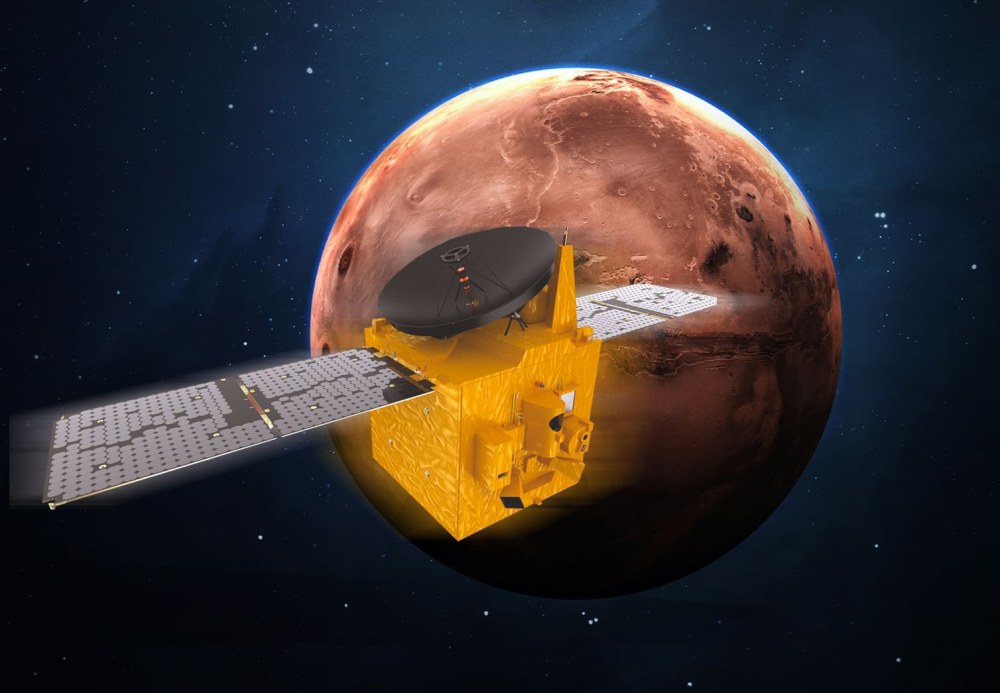
These projects, alongside the Hope Probe’s ongoing Mars atmospheric research, underscore the UAE’s trajectory as a primary player in global space exploration.